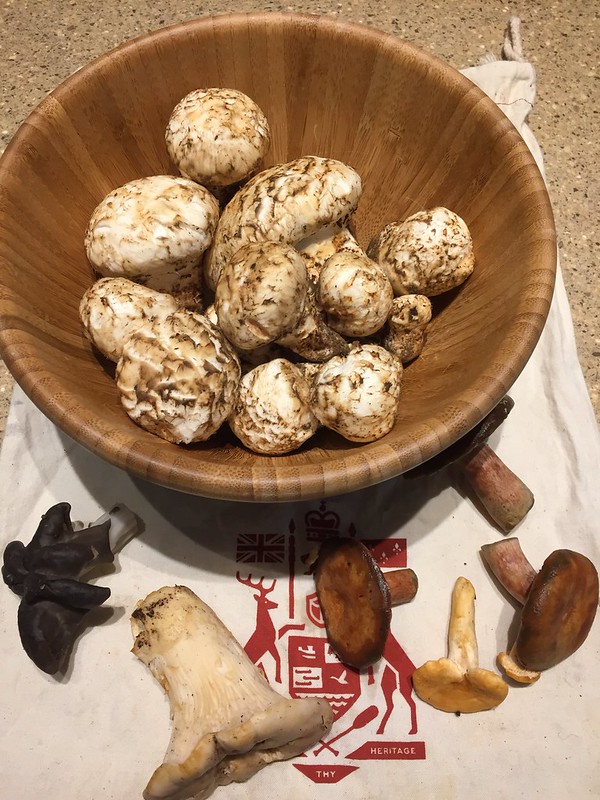
Above lower left, the one White Chanterelle that I brought home. Even when they were newly emerged (last two weeks?) like this one, most were too waterlogged to bring home.


 |
| Smith's Amanita taken by Joe Anderson, http://www.inaturalist.org/photos/568041 |
| Common Name | Pine Mushroom, Matsutake |
Fragrant Tricholoma, Fragrant Boot, Booted tricholoma, Fragrant Armillaria | Cat, Big Cat, Imperial Cat | Smith's Amanita |
| Scientific Name |
Tricholoma magnivelare | Tricholoma caligatum (formerly - Armillaria caligata) | Catathelasma ventricosum and Catathelasma Imperiale | Amanita smithiana and Amanita silvicola |
| Main Distinction from a Pine Mushroom | There appears to be a growing concensus that the mushroom we call a Pine here on Vancouver Island is Tricholoma magnivelare and that it is different from Tricholoma matsutake. The similarities are, however, so striking that for our pruposes we can call our Pine a Matsutakes. |
Generally more brown with more fibrils on the
cap Smaller cap when mature Boot shaped fibrous veil (sometimes) highly variable taste, usually bitter Less common |
Double veil and amyloid spores. (Double veil
can be hard to distinguish More grey or brown than white No spicy odor Prefers Spruce Larger -- can have caps that are a foot across when fully mature (Imperiale) Both are rare on Vancouver Island |
Usually ghostly white, with a more slender
stipe, and covered in fluffy ragged patches and warts Firm, but not as firm as a Pine Mushroom and not as likely to pull apart like string cheese. Usually smells different than a Pine, unpleasant. |
| Cap | Dry Mostly White Smooth, sometimes with faint scale-like brown splotches. Others describe as "slightly shaggy" Occasionally grey or brown in colour all over Cap edge is in-rolled 5 - 20 cm or larger |
Dry Mostly brown (light to deep brown to chestnut) surface over white Others describe the colour by refering to the prominent dark brown vinaceous fibrils that cover white flesh, sometimes separating in age to reveal the whitish or pinkish flesh beneath. Cap edge is in-rolled 4 - 12 cm across Sometimes with remnants of the partial veil attached, most of which remains as a ring. |
Generally dry but Imperiale can be sticky
with young. Brownish to grey. Cap edge has a strongly in-rolled margin 5 - 15 cm (ventricosum) 5 - 40 cm (Imperiale) |
Moist or dry White with cotton -like warts Punky Often presence of clingy cottony remnants of veil hanging from edge of cap 12 - 20 cm across or 5 - 17cm across (depending on age) |
| Gills | White to cinnamon coloured with age Tricholoma means it has notched (adnexed) gills, white spores, and is mycorrhizal (symbiotic relationship with photosynthesizing plants/trees) |
White, becoming spotted brown with age Tricholoma means it has notched (adnexed) gills, white spores, and is mycorrhizal (symbiotic relationship with photosynthesizing plants/trees) |
Long, decurrent, crowded, narrow Extend down stipe |
White to cream coloured sometimes pinkish,
closely crowded, floccose edges free to narrowly adnate, sometimes with a faint decurrent line on stem apex, close to crowded |
| Spores | White | White | White, amyloid | White |
| Stipe | Firm Pointed at the base White above ring white below ring but often with brown streaked areas Sometimes expanded at base Usually grey soil and fibrals at base |
Firm Pointed at the base White but often also covered with brown fibrils or reddish brown spots (with age) |
Firm Pointed at the base |
Firm, but generally not as firm as Tricholoma
magnivelare White, usually above and below ring. veil leaves soft powdery or cottony covering. Generally thickening towards base but can be pointed at base or club shapped Can have Often grey soil at base. |
| Veil | Thick membranous Sheaths the stipe, white at first, forming prominent cottony ring that flares out at first, then collapses against stem when old |
Stipe below the ring often bears brown fibrils like those on the cap, giving the mushroom the appearance of wearing a boot, hense, caligatum (Latin for boot) | has two viels, an inner one that leaves a ring on the upper stipe, with one lower down as well. | shaggy cotton-like remnant remains on young speciments, leaves a fragile, ragged ring that easily falls off. |
| Habitat | Conifer forests |
Conifer forests | Under sitka spruce, western hemlock &
Douglas fir Usually in calcareous soils forming arcs or rings of fruiting bodies |
Conifer forests, also alder and mixed forests Can be soil or well-rotted wood |
| Odor and Taste | distinctly spicy-aromatic. "organic (not earthy or mushroomy) smell" |
Usually reported to be unpleasant in
the PNW. Sometimes claimed to have a similar odor to
magnivelare. Some claim it is a minder smelling mushroom while others claim caligatum is more cinnamony. |
Has a strong farinaceous odor and taste. A
common mushroomy smell like that of cucumbers, watermelon
rind, or an old grain mill "tastes mealy" - http://www.mushroomexpert.com/catathelasma.html |
Not spicy, often described as chlorine like,
often as unpleasant. Also described as mild to pungent. A number of reports say it smells similar to a Pine Mushroom. |
| Edibility | "...sometimes edible and good, but sometimes very bitter and foul tasting." - Tom Volk | |||
| Indicator Species | Candystick (Allotropa vigata) or Booted Knight (tricholoma focale) | |||
| Notes | Stipe peels somewhat like string cheese. Usually distributed in clusters on the narrow mountain ridges and southfacing slopes. |
"Another similar species, the booted
tricholoma..., can be found mixed with pine mushroom at
buying stations in British Columbia (Marty
Kranabetter, B.C. Ministry of Forests, and Tyson Ehlers,
Tysig Ecological Consultants, pers. comms., 2000)"- BC
Journal of Ecosystems and Management Is the booted
tricholoma in British Columbia really Japanese matsutake? A California version of Tricholoma caligatum (sensu Shanks, 1994) grows under conifers from "November to December in northern coastal forests and low elevation montane forests of the Sierra Nevada"; it is extremely bitter. Given its widely different mycorrhizal associations, it may well be a distinct species. I have collected a mild-tasting form of Tricholoma caligatum under spruce and fir in the Rocky Mountains. - http://www.mushroomexpert.com/tricholoma_caligatum.html "Tricholoma caligatum smells weakly of matsutakes and indeed is often collected and eaten as such." - Britt A. Bunyard "There are more and darker (purplish-brown) fibrils or scales on the cap and stipe of T. caligatum, which is smaller and less robust [than magnivelare]. Its aroma also has a sharper, cinnamon candy (Red Hots) component lacking from the pine mushroom’s musty and spicy smell." - http://bcmushrooms.forrex.org/ntfp/pages/trichomagniv/trichomagniv_syn.html |
There are two species, both occure in the
Pacific Northwest, Cathathlasma ventricosum (pale grayish
cap) and C Imperiale (brown Cap) No official confirmation it occurs on Vancouver Island |
Often tall stature and "ghostly
white all over" Warts can become tan colored when dried out Usually appears to have a ragged scaly stem with spindle-shaped bulb that is often rooting Very common An old specimen can look quite different from a fresh one "Amanita smithiana has free gill attachment and being from section Lepidella, it is quite powdery. The texture of the flesh should be pretty different as well. Matsutake has a pretty stringy texture, while Amanitas can not be peeled like string cheese." |
