Sunday, November 18, 2012

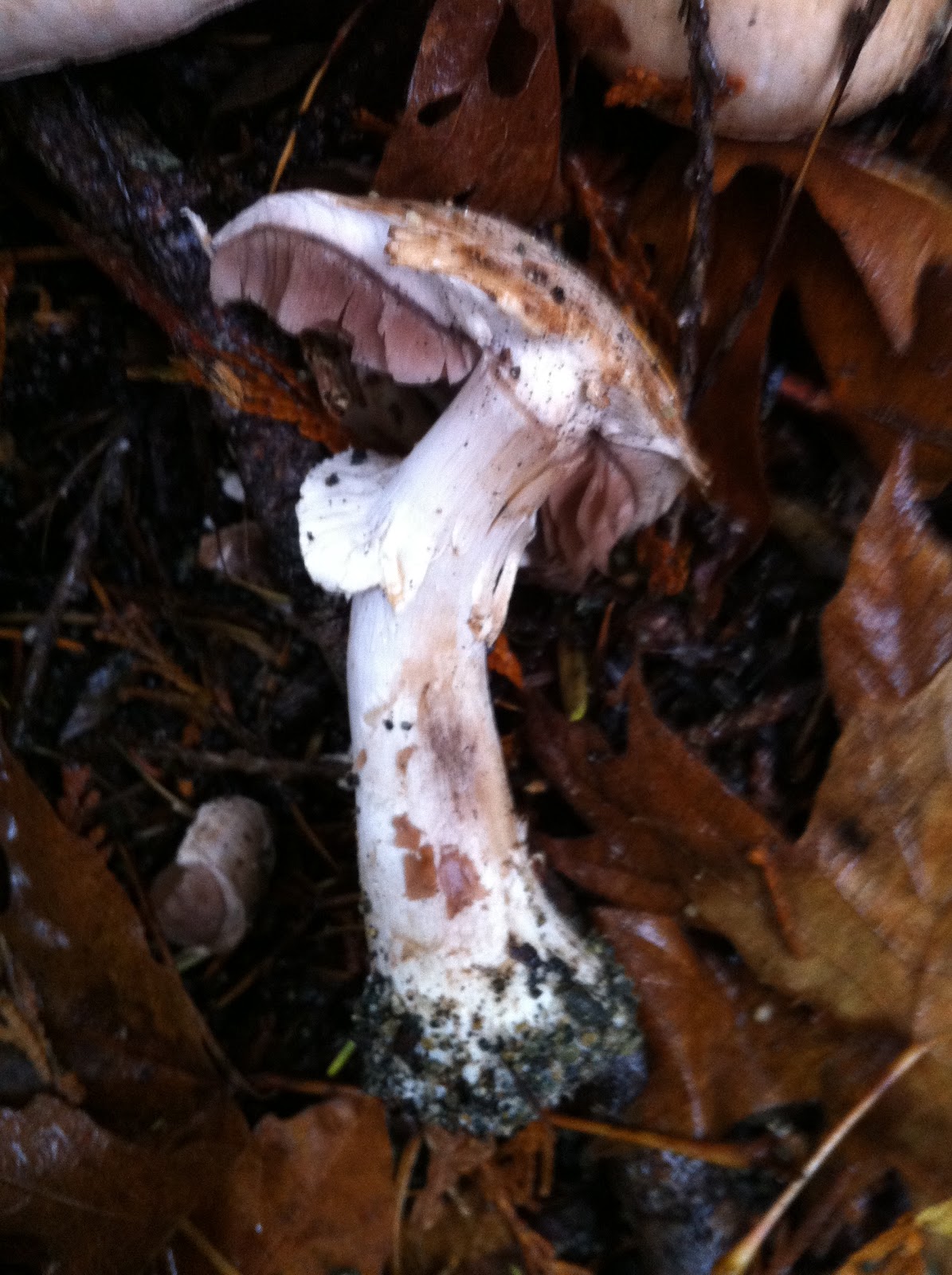
Agaricus hondensis?

For three years now I have seen this "Meadow Mushroom" on one of my frequented walks. The first year I saw it, it was growing practically out of a newly deposited pile of fill, very gravely and barren. It had been trampled by children, so I only looked at it briefly. The second year the gravel had been taken away for use in trail construction, but the mushrooms were there in the same spot. They were soggy and buggy, so I did not bring one home.
Agaricus hondensis?
Today I found the patch not in the exact spot, but further up the trail by a couple of yards. They seemed firm and smelled nice, so I brought three home. There was something unsettling about their shape however, so I did some research.
Or possibly Agaricus moelleri
Both Agaricus moelleri and hondensis have more substantial rings than Agaricus campestris (Meadow Mushroom). The more mature of the three specimen has a largish felty ring so one strike against them being campestris.

Moelleri, however, does not have pink gills, which these specimens seem to have.

Hondensis is said to have "pinkish" gills when young, and the stipe is said to exhibit a phenolic odor (as does moelleri) which these specimens exibit. The stipe base of hondensis is also said to bruise light chrome yellow which this one seems to do. Hondensis is also said to prefer forested habitat, which is where I found these specimens.

So, despite it's pink gills (suggesting a Meadow Mushroom) and despite it's marshmallow shaped cap suggestive of moelleri, I will, for now, go with Agaricus hondensis.

Moellari is said to stain bright yellow at the very base of the stipe (the base of the three specimens I found were punky and beginning to rot so I could not use this test) and moellari sounds like it is more common, but still, I will stay with hondensis based on the colour of the gills.

I am open to comments from anyone who knows these mushrooms better than I.

Monday, November 12, 2012

Slimy Gomphidius (Gomphidius glutinosus)

I walked a long ways today and only found two Chanterelles and they were small and going brown at the edges.

The Slimy Gomphidius are out in fair abundance, however.

Here is the first one I spotted:

They were absolutely covered on the underside by little black jumping bugs:

There were a lot of little mushrooms growing on logs. In particular abundance were these little beauties:
Maybe Bleeding Mycena? Didn't try to see if they bleed...

Also some bright yellow ones I can't even begin to identify:
No clue what these are...

Thought at a distance these might be Winter Chanterelles, but nope, not sure what they are:
Not a clue...
Ok, this one I think I know:

Think it is Shaggy Stalked Parasol (Lepiota clypeolaria)
Shaggy Stalked Parasol (Lepiota clypeolaria)
See the whole album of photos from today here: https://plus.google.com/photos/103797335525010294456/albums/5810118236297268497?authkey=CImN07u42LDiwAE

Sunday, November 4, 2012

Recommended Workshop -- Beginner's Wild Edible Plants and Mushrooms with Jessica Wolf


I have taken two of Jessica Wolf's workshops and found them to be interesting and informative. Jessica is a great presenter and guide, both for kids and adults, and very knowledgeable about mushrooms. I recommend her workshops highly.

Lycoperdon perlatum, Gem-studded Puffball

Probably Lycoperdon perlatum, Gem-studded Puffball
First sighting of the Gem Studded Puffball in an area I have seen them before. It was September 18, 2010 when I found one big enough to take home and eat. I was not impressed with the flavor.

These usually appear from July to October, so again, we have evidence that the fruiting season this year is a month or more behind. 

Saturday, October 27, 2012

White Chanterelles (Cantharellus cibarius)

Today I walked for an hour in the place I found the Clavariadelphus truncatus (Flat-Topped Coral Mushrooms) last year without seeing anything except a gazillion Strobilurus trullisatus (Douglas Fir ConeMushrooms).

It was raining steadily and I was just about to head home, feeling very dejected, when I tried one more stand on the other side of the road.


There it was, gleaming in the growing dusk. The rain was coming down so hard I didn't take any more pictures -- till I got home.

White Chanterelles Washed and Wonderful
So yeah, while it meant walking back to the car in the dark, It turned out to be a great patch.

Interestingly it seemed to be the only area that had them and other mushroom pickers had been there earlier (saw several places where severed stipe ends were showing), probably this week, and most of the Chanterelles were just emerging, so lots of fir needles coating them. A handful were firm and on the dry side, and I think they had been out longer, but all the others were new and tender.

So I would say that the season if finally underway! Yahoo!

I tried brushing the needles off with my mushroom brush, but gave up on that and washed them. The smell of the mushrooms after being enlivened by the water -- well -- sweet and Chanterelley. 

Sunday, October 21, 2012

First Chanterelle and Califlower in Nanaimo Area

Last weekend I walked in local parks and saw only one mushroom, a Shaggy Mane (Coprinus comatus) which was in a public area, so I did not pick it.

My finds today were a Cauliflower and a few small Chenterelles.

Here is the Cauliflower:
 Note the blue mold on it. I saw mold on several Chanterelles too, which leads me to think they came out earlier in the fall, and have been sitting here for quite a while.

Here is a Chanterelle completely covered in the blueish mold:

I walked for several hours and checked out a few spots that I know have had Chanterelles two years in a row.  Finally on a low spot where a creeks flows in the winter, in near some exposed bank, I found a few fresh ones, peaking out:

They were really small and I didn't pick them. A little further down the gully I found some more and took a picture with my headlight to show the size:

Then, finally I found a few worth picking:

No Slippery Jacks or Gomphidius or any of the common non-edibles. Did see a few Fir Cone Cap and some LBMs.
Some folks are saying we may not get the regular flush this year, and maybe not with the long Indian summer and no rain. Still, with all of November before us, I'm staying optomistic.

Sunday, September 30, 2012

Conifer Coral Hercium (Hericium abietis) and Lobster Mushroom (Hypomyces lactifluorum)

After stopping at the Coombs market, where I discovered several excellent olive oils, I went to a nearby forested area and found a Conifer Coral Hercium (Hericium abietis) and a Lobster Mushroom (Hypomyces lactifluorum).

The Lobster was actually still mostly underground. I removed the duff to expose it and took this photo:

Here is the habitat it was in:
See it there on the right adjacent to my pack?

Then about a kilometer away (yeah, I walked about 4 k today in some fairly steep terrain and found only two edible mushrooms) was this beauty:

I carefully sliced it off the log and brought it home.

Where I took a close-up video of it and the lobster.

Of course when I cut into the Hericium, it was full of worms. The Lobster was not, it was nice and clean. I carefully trimmed out some of the least wormy bits from the Hericium and cooked them up to have with supper. Somewhat similiar to the Hedgehogs in flavour and more toothy.Think it would be better in a soup with a long simmer.

Will try the lobster tomorrow night.

Monday, September 17, 2012

First Golden Chanterelles

While paddling in the Sayward Forest north of Campbell River on Saturday September 15th 2012 I decided to have a little look in a promising patch of forest in the hills above Brewster Lake. Seconds after stepping off the road I found these little lovelies.
Curiously I walked for 20 more minutes looking and did not find any more, but I cooked them up and ate them within a few hours of finding them. They were very firm and mild tasting. I walked in a forest in South Nanaimo on Sunday and did not see any sign of any mushrooms, so perhaps we have not had enough rain here to trigger the fruiting, but I'm sure we will be seeing them soon.

Monday, December 12, 2011

Maybe the Golden Chanterelles Where Late This Year?

It occured to me today, when I saw two more lights shining in the forest that turned out to be Golden Chanterelles, that it was white chanterelles I collected earlier in the season. Maybe with the funny weather in August and September (touch of rain in August, stretch of sun in September) that the Golden Chanterelles came out in early September, and this is a second, staggered bloom late in the season?


They are definitely mature, but not waterlogged, and these were, like the one's I got yesterday, tight in near trees, away from frost and rain. So maybe it is just that the bushes have lost their leaves and so there is a little more vista in the forest and otherwise hidden mushrooms become visible.

Whatever the explanation, it is a happy discovery.

Sunday, December 11, 2011

Ok, so the Season Goes on a Little Longer...


I was out for a walk today and enchanted by a patch of little mushrooms glowing in the dimness, possibly Mycena alcalina, and that pulled me off the trail where I found some greenbacks (winter oysters) just starting to show.


Later at another site in the forest I saw a little chanterell peaking out of the moss and thought of "Stay in the Wild's" video in which he finds chanterelles on January 15th.


So I wandered into the forest and within a few minutes, using Stay in the Wild's technique of looking near debri that would shelter the chenterelles from frost, I found some nice ones.


It was getting dark, so I headed for home. The thermometer outside my office window read 2 degrees. Gotta love it -- chanterelles on December 11th!

Sunday, November 27, 2011

Remains of the Season -- Chanterell, Hedghog, Cailiflower, Meadow Mushroom

Drove to my reliable picking spot about 20 minutes from my house to see if there was anything left in the woods after the cold snap.

There was still snow in the ditches of the logging road (it has warmed up a lot since then).

The place was clearly picked over, lots of evidence of other pickers, which is to be expected so close to town, but within an hour  I found some waterlogged chanterelles still worth picking (and some I left in the field that were not!) and a bunch of small hedghogs, nothing very big.

Lots of rotting mushrooms of all sorts, clearly done in by the snow.

Here is what I came home with:


Brought home a sample of the mushroom I thought might be a Meadow. Sure looks like it is, but also looks like the bugs beat me too it. Might be the same story with the Cauliflower, which I was shocked to find within feet of the road at this time of year. One Cauliflower I saw the other day was past its prime, but this one looked ok in the failing light. I will wash it up and see.


Meadow Mushroom? Agaricus campestris


This little patch of mushrooms sprang up this last week.I took these photos on the 22nd. I think these may be meadow mushrooms, as I found a patch of meadow mushrooms earlier in the year not far from here. They had the distinctive pink gills, but these are not as noticibly pink. Matchmaker gave one response to my entry -- Agaricus campestris, so it probably is.

Trouble is it could be Agaricus hondensis which is toxic, or Agaricus moelleri, etc. too many look alike agaricus for me to trust identification without someone who knows for sure to guide me. It could of course be Agaricus subrutilescens, another prized edible. Maybe I'll bring one home tomorrow for a closer examination.


I found my first patch of hedghogs today. Have not had a chance to do any foraging except on my regular walks from the house, and I keep thinking that this late in the season I won't see anything. Going to have them for breakfast...

Monday, November 7, 2011

Helvella lacunosa (Fluted Black Elfin Saddle) and Laccaria amethysteo-occidentalis (Western Amethyst Lacciaria)

What a pleasant day I had. I went out with a good attitude, a light heart, just curious and not expecting to find any edible mushrooms. My stick in hand, 10 degrees, warm gloves, and a warm jacket. I thought to seek a route through the forest between two of my well traveled paths so that I might have a nice loop for future walks.

The first fungi of interest was Helvella lacunosa (Fluted Black Elfin Saddle). These were truly tiny specimens that I didn't at first see.


I was in a spot where I had found Hedgehogs last winter and where I found Chanterells in early October this year. They had come up in late August or early September sometime following the brief rains at the end of the summer. By the time I found them they were too far gone. It is a place in the middle of a forested area but it gets very wet at certain times of the year. I guess the low ground, between two rocky knolls catches the run off.

A little higher up I found more Elfin Saddle's with the commonly occurring parasitic mold (Hypomyces cervinigenus) all over them.


Pablo in this video says they are good to eat: http://youtu.be/jPSxLvHF3x0

He says he thinks they taste better than Morels. J. Duane Sept says that they may contain a small amount of a toxic substance, monomethylhydrazine, which is realsed  if dried or parboiled for 3 to 5 minutes.

I wandered for quite a while and then found some Chanterells, a little waterlogged and near the end of their usefulness, and then found my first Lactarius rubrilateus, or Bleeding Milk Cap.

There were many "little white mushrooms" and the first choral fungas I have seen this season (Ramaria acrisiccescens, or Ramaria flavigelatinosa, or Ramaria formosa complex, perhaps?).


I found a nice patch of Laccaria amethysteo-occidentalis on a moss covered rocky shelf.


On the way home I found a delightful patch of Boletes with several specimens snuggled up to some, what I think were, Slimy Gomphidius (Gomphidius glutinosus).


Charming.

Monday, October 31, 2011

Clavariadelphus truncatus -- Flat-Topped Coral Mushroom

Spent several hours today walking in a couple of different woods after two weeks full of long days at work that did not allow me to get out. I walked a long way and saw thousands of mushrooms, but for the first two hours, none of them edible.

I finally found and brought home some Chanterells (several white, two golden) and two Boletus mirabilis, the Admirable Bolete. I had seen Mike Orr's video of the Admirable and although I had not remembered seeing any before, low and behold, today, I saw three of them! Only two worth bringing home, but the one I left in the woods (past it's prime) was the largest.

I also saw great quantities of Clavariadelphus truncatus, in both locations. It is a fungus I had not seen before, and so left in the field. I took two pictures with my iPhone and identified it when I got home:

Turns out I should have gathered some. "This is a fine edible wild mushroom -- often firm, always tasteful, and certainly unusual...Saute it or bread and deep-fry it for an unusual side dish." raves Fisher and Bessette in Edible Wild Mushrooms of North America.