Sunday, November 27, 2011

Remains of the Season -- Chanterell, Hedghog, Cailiflower, Meadow Mushroom

Drove to my reliable picking spot about 20 minutes from my house to see if there was anything left in the woods after the cold snap.

There was still snow in the ditches of the logging road (it has warmed up a lot since then).

The place was clearly picked over, lots of evidence of other pickers, which is to be expected so close to town, but within an hour  I found some waterlogged chanterelles still worth picking (and some I left in the field that were not!) and a bunch of small hedghogs, nothing very big.

Lots of rotting mushrooms of all sorts, clearly done in by the snow.

Here is what I came home with:


Brought home a sample of the mushroom I thought might be a Meadow. Sure looks like it is, but also looks like the bugs beat me too it. Might be the same story with the Cauliflower, which I was shocked to find within feet of the road at this time of year. One Cauliflower I saw the other day was past its prime, but this one looked ok in the failing light. I will wash it up and see.


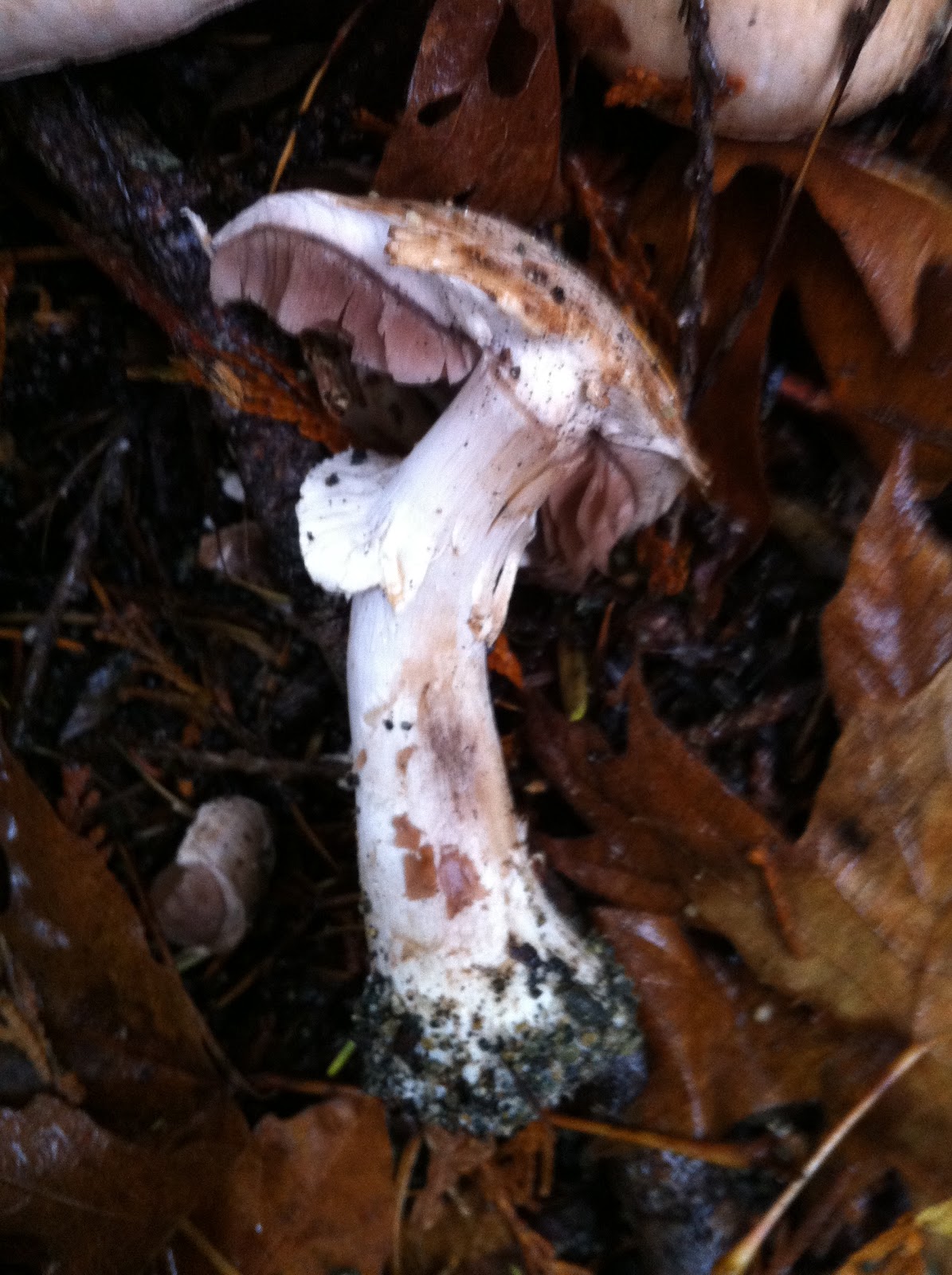
Meadow Mushroom? Agaricus campestris


This little patch of mushrooms sprang up this last week.I took these photos on the 22nd. I think these may be meadow mushrooms, as I found a patch of meadow mushrooms earlier in the year not far from here. They had the distinctive pink gills, but these are not as noticibly pink. Matchmaker gave one response to my entry -- Agaricus campestris, so it probably is.

Trouble is it could be Agaricus hondensis which is toxic, or Agaricus moelleri, etc. too many look alike agaricus for me to trust identification without someone who knows for sure to guide me. It could of course be Agaricus subrutilescens, another prized edible. Maybe I'll bring one home tomorrow for a closer examination.


I found my first patch of hedghogs today. Have not had a chance to do any foraging except on my regular walks from the house, and I keep thinking that this late in the season I won't see anything. Going to have them for breakfast...

Monday, November 7, 2011

Helvella lacunosa (Fluted Black Elfin Saddle) and Laccaria amethysteo-occidentalis (Western Amethyst Lacciaria)

What a pleasant day I had. I went out with a good attitude, a light heart, just curious and not expecting to find any edible mushrooms. My stick in hand, 10 degrees, warm gloves, and a warm jacket. I thought to seek a route through the forest between two of my well traveled paths so that I might have a nice loop for future walks.

The first fungi of interest was Helvella lacunosa (Fluted Black Elfin Saddle). These were truly tiny specimens that I didn't at first see.


I was in a spot where I had found Hedgehogs last winter and where I found Chanterells in early October this year. They had come up in late August or early September sometime following the brief rains at the end of the summer. By the time I found them they were too far gone. It is a place in the middle of a forested area but it gets very wet at certain times of the year. I guess the low ground, between two rocky knolls catches the run off.

A little higher up I found more Elfin Saddle's with the commonly occurring parasitic mold (Hypomyces cervinigenus) all over them.


Pablo in this video says they are good to eat: http://youtu.be/jPSxLvHF3x0

He says he thinks they taste better than Morels. J. Duane Sept says that they may contain a small amount of a toxic substance, monomethylhydrazine, which is realsed  if dried or parboiled for 3 to 5 minutes.

I wandered for quite a while and then found some Chanterells, a little waterlogged and near the end of their usefulness, and then found my first Lactarius rubrilateus, or Bleeding Milk Cap.

There were many "little white mushrooms" and the first choral fungas I have seen this season (Ramaria acrisiccescens, or Ramaria flavigelatinosa, or Ramaria formosa complex, perhaps?).


I found a nice patch of Laccaria amethysteo-occidentalis on a moss covered rocky shelf.


On the way home I found a delightful patch of Boletes with several specimens snuggled up to some, what I think were, Slimy Gomphidius (Gomphidius glutinosus).


Charming.

Monday, October 31, 2011

Clavariadelphus truncatus -- Flat-Topped Coral Mushroom

Spent several hours today walking in a couple of different woods after two weeks full of long days at work that did not allow me to get out. I walked a long way and saw thousands of mushrooms, but for the first two hours, none of them edible.

I finally found and brought home some Chanterells (several white, two golden) and two Boletus mirabilis, the Admirable Bolete. I had seen Mike Orr's video of the Admirable and although I had not remembered seeing any before, low and behold, today, I saw three of them! Only two worth bringing home, but the one I left in the woods (past it's prime) was the largest.

I also saw great quantities of Clavariadelphus truncatus, in both locations. It is a fungus I had not seen before, and so left in the field. I took two pictures with my iPhone and identified it when I got home:

Turns out I should have gathered some. "This is a fine edible wild mushroom -- often firm, always tasteful, and certainly unusual...Saute it or bread and deep-fry it for an unusual side dish." raves Fisher and Bessette in Edible Wild Mushrooms of North America.

Sunday, October 9, 2011

Coprinus micaceus (Glistening Inkcap) or Coprinus Atramentarius (Alcohol Inky)

I shot some footage of a lovely mushroom growing on the side of a dead tree. I think it is Glistening Inkcap or possibly Alcohol Inky and will check further when I have time to do some reading.


Here are some still shots:


Sarassis crispa (Cauliflower Mushroom)

Last weekend I found two nice specimens of Sparassis crispa, or Cauliflower Mushroom. The first one was emerging from under some woody debri near a decaying stump:


The second was in a fairly public spot and I didn't take a photo of it. I cut 1/2 of each specimen to take home and left the rest to grow larger.

Today I found the first site undisturbed and the remaining fruiting body had grown, emerging out from it's hiding place.


The second more public site did not contain anything. The 1/2 mushroom I had left was gone but the harvester had used a knife to cleaning remove it. So it should come back next year.

Trudell and Ammirati say that Sarassis crispa looks more like egg noodles than cauliflower, and I would agree. They also say that it would be hard to confuse this mushroom with any other and although I had identified it solely from books, I ate some last week and more today. Last week when very fresh I just fried some in butter with my breakfast and it was good. Today I par-boiled and fried it along with some chanterelles. The texture is definitely chewy but the flavour is very nice.

Suillus luteus and Suillus lakei

I found three boletes today and I wasn't sure if they were the same or different. The first was on a stoney shelf in the moss under conifers, mostly Douglas fir and cedar. It clearly had the remnants of a veil, ruling out Suilus brevipes (short-stemmed slippery jack), although that was my first guess because of the bald cap and lack of scales.


Matchmaker posited many different options none of which seemed right. So I did a spore print while I ate turkey dinner, and have now run it again. The spore print is olive to olive brown, there is a veil, and it does not stain to blue but does turn darker brown when cut. Matchmaker now gives me Suillus luteus (Slippery Jack) which seems right. Matchmaker described the spore print as '"sayal brown" to "clay color" -- Bessette. This is very accurate to what I am looking at.

The other two boletes seemed much easier to key. The first had clear scales on the cap and a ragged veil so going by J. Duane Sept, it sure looks like Suillus lakei (Western Painted Suillus). Interestingly Matchmaker did not give this result at first, but after entering as much information as I could think of it did, so I feel pretty confident about this one.


The last one was much more yellow but since it was not blue staining and had the veil, I'm going to peg it as the Suillus lakei too.


Wednesday, September 28, 2011

Cantherellus subalbidus (White Chanterelle) and Cantharellus formosus (Pacific Golden Chanterelle)

Mike Orr's video from the 23rd motivated me to get in the vehicle and drive to some spots where I have found Chanterelles in the past. The first 1/2 hour was disappointing, and then I stumbled upon a patch of tinny golden Chanterelles.


Interestingly there was evidence that someone else had been there before me -- I could see the neatly cut stipes of larger mushrooms beside the small ones I found. I wandered around in a wider circle, went up the hill a ways, found nothing, so circled back and proceeded downhill from where I had found the small ones. Then I came across a patch of White Chanterelles and picked a bag full.


I walked quite a while after that but did not find another patch.

I did, to my great joy, find a red legged frog. Quite unexpected in the forest. And she sat still so I could take some photos with my iPhone.


After leaving her to her -- I'm not sure what -- burying herself in the mud for the winter??? I went down the road to another place I have had luck in the past and found one small Golden Chanterelle in well over an hour of tramping through the wet salal and deep woods.


It was a lovely spot with the sun streaming through the trees and just before I gave up I came around a big old stump and found this:


The fungus had an unpleasant smell.


 But was impressive in heft and detail.


 A little further on I found some polypores:


I'm going to guess that this is Coltricia perennis (Tiger's Eye). There were several lovely speciments:

Monday, September 26, 2011

More on Gymnopus dryophilus (with a little Allotropa virgata for interest)

Took a video today of a patch of Gymnopus dryophilus:

I walked for over 8 kilometers today and all I saw were these mushrooms in several fairly large patches. Interestingly the Wikipedia entry for this mushroom says, "often seen when there are few other fungi in evidence." That would seem to describe my walk today. I did, however, see this:
Allotropa vigata??
I believe this is the remains of "candystick" which is an indicator species for Matsutake or Pine Mushroom (Tricholoma magnivelare).

"Allotropa virgata lacks chlorophyll, it obtains nutrients from other vascular plants through a mycorrhizal (fungal) association. Matsutake mushroom mycelium are reported as the mycorrhizal associate." -- http://fieldguide.mt.gov/detail_PDMON01010.aspx

So, I will be checking this spot over the next two months to see if I find a Matsutake or not.

Sunday, September 25, 2011

Gymnopus dryophilus 76%

I collected a sample and did a spore print overnight. Then I ran all the variables through Matchmaker. it came up with only one option: Gymnopus dryophilus, or common Collybia.

Here is the spore print:
I've interpreted this as cream, pale yellow, yellow-brown, or orange brown. The photos doesn't really look like it does with the naked eye. I would say it is more cream than anything.

Matchmaker is a very interesting and complex program. I can't believe all the variables. The algorithms must be "gnarly dude."


It is a nice looking fungus, with a pleasant fungusy smell.


When I use the little option in Matchmaker for reducing the percentage match it gives me other choices.
  1. Lepista inversa*  63%
  2. Paxillus involutus*  61%
  3. Gymnopus confluens*  61%
  4. Cortinarius semisanguineus*  61%
  5. Clitocybe albirhiza*  61%
Of these, Lepista inversa and Cortinarius semisanguineus also look like good candidates. Except that my specimen does not have "decurrent gills that become cap-colored." Well, they are cap-colored, but not decurrent (extending down the stem below the point of attachment).

Cortinarius semisanguineus looks more like my specimen in some ways but mine is probably not as brown and with a thinner stipe, and definitely not red to brown spores.

So, based on the information I was able to enter, this is probably Gymnopus dryophilus. It sure smells nice, but it will take a few more years of learning about identification before I will even consider eating one!